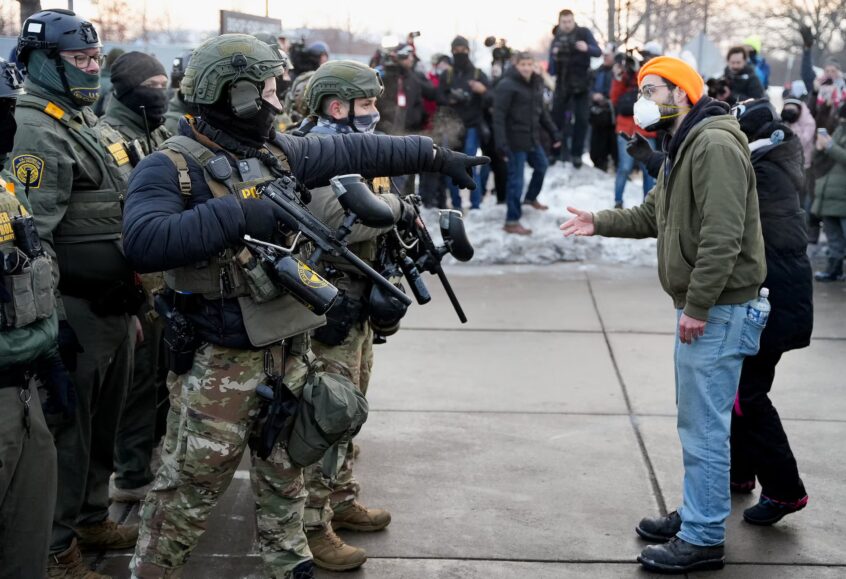
There is a profound difference between enforcing the law imperfectly and breaking it intentionally—and confusing the two is how societies lose both justice and life.
This is at least one (hopefully humble) answer to those who ask, “Why don’t you give equal treatment in this moment and call out federal agents, including those with Immigration and Customs Enforcement (ICE), when their actions break the law?”
To that very question, here’s further reasoning for my personal response earlier regarding the illegal intrusion at Cities Church by pseudo-protestors and what some think is a lack of response to illegal acts by law enforcement.
To the specific question above: Yes, authorities can — and should — correct unlawful actions even by those trying to uphold the law. To hold everyone accountable to the law — whether a protester, a local official, or a federal agent — is consistent with the biblical call to justice (Amos 5:24; Micah 6:8) and with the civil principle that no one is above the law.
Assuming recent reports are true, we must, then, recognize and admit that ICE and possibly other enforcement agencies have apparently made critical errors in judgment and practice, even while pursuing the enforcement of the law. Some of these situations have sparked serious concerns about legality, and there seems to be valid grounds for public and legal examination of how federal law enforcement carries out its mandate. To that assumed reality, my answer is simple and grounded in principle: we should not hesitate to call out unlawful or dangerous actions by any party — including ICE — when they overstep legal and moral boundaries. Holding institutions and authorities accountable under the law is not only consistent with our advocacy for justice, it is indispensable to it.
However, it is important to distinguish calling out wrongdoing and demanding accountability from pretending all wrongdoing is equal. Those two things are not the same. We should want the former; we should reject the latter. This essential understanding rests on intent, responsibility, and role.
Intent matters. One can call for correction of a wrong method, accountability, reform, and improvement in training and oversight while still recognizing that those actions are meant to serve the law, even if, at times, they fail in execution. But you cannot excuse a willful choice to break the law or justify unlawful action on the basis of desired ends. That would undermine the very rule of law that protects every life and every community.
Roles matter. Society assigns different authority, limits, and expectations to different sectors. Law enforcement officers are authorized to act on behalf of the public to uphold the law; protesters are not. That distinction is not arbitrary—it exists to prevent chaos and protect life. When those tasked with enforcing the law act, even imperfectly, they do so within a defined framework of accountability, oversight, and legal constraint. When private citizens take it upon themselves to intrude, obstruct, or coerce, they are not exercising conscience but assuming authority they do not have. Confusing those roles collapses the boundaries that keep disagreement from turning into disorder.
Responsibility matters. Authority always carries accountability. Those entrusted with enforcing the law are rightly subject to scrutiny, investigation, and correction when they misuse their authority. We can demand reform and accountability precisely because their responsibility is to uphold the law, not to override it. But responsibility also applies to citizens, who are called to dissent without destroying the legal structures that make dissent possible. One can correct a wrongful method while still affirming a rightful mission; one cannot affirm a wrongful intention without justifying the harm it produces. Justice depends on holding people accountable not only for what they do, but for why they do it and whether they had the right to do it in the first place.
Case in point: When Eric Rudolph carried out a series of bombings at abortion clinics between 1996 and 1998—killing people and destroying property—Christians who opposed abortion overwhelmingly and unequivocally condemned his actions. They did so not because they were suddenly uncertain about the moral evil of abortion, but because they understood that murder cannot be a moral response to murder. His intent was not to uphold the law or protect life through just means, but to impose his convictions through violence. That distinction mattered then, and it matters now: a right conviction pursued through unlawful and coercive action becomes morally indefensible, regardless of the cause it claims to serve.
The short answer? I think we should affirm and pursue accountability and the rule of law across the board, without equating fundamentally different intentions. Justice, accountability, and reform must be pursued within the frameworks that protect both public safety and human rights. To do otherwise is to surrender the very principles that make justice sustainable and life preservable.